Table of contents
Everyone says travel “broadens the mind”, yet the sharpest lessons often arrive in the smallest moments, the pause before a handshake, the silence after a joke, the look that says you missed the point. After years of mass tourism and algorithm-fed “must-do” lists, destinations can feel interchangeable, and still, cultural friction remains stubbornly real. It is also where travel becomes more than consumption, because misunderstandings reveal values, and values shape how cities move, eat, queue, tip, flirt, and forgive.
When “normal” fails at the airport
It starts early, sometimes before baggage claim. In Japan, a phone call on a train can draw quiet disapproval, while in parts of Southern Europe, animated conversation is the soundtrack of public life; neither is rude in context, but the visitor carries an invisible rulebook, and it often collapses on arrival. Airports and transit systems are where these hidden norms become measurable, and data helps explain why: Japan’s rail punctuality, for instance, routinely sits around the sub-minute mark on major lines, a performance tied to a culture of collective consideration and procedural discipline, whereas New York City’s subway reliability has long been a political issue, with delays and maintenance backlogs shaping a different tolerance for friction.
Queueing is another instant collision. The UK famously treats the line as a social contract, and cutting in is a moral offense; in other places, crowds bunch and flow, and assertiveness can be read as competence rather than disrespect. Researchers who study “tight” and “loose” cultures, including work popularized by psychologist Michele Gelfand, point to variations in how strongly societies enforce norms, and how much deviation they allow, with tighter cultures typically showing higher rule adherence and stronger social monitoring. For the traveler, the practical takeaway is blunt: the same behavior can signal entitlement in one country, and efficiency in another, and you will be judged accordingly even if nobody says a word.
Then come the small talk traps. In the United States, “How are you?” is often a greeting, not an invitation to detail; in Germany or the Netherlands, a direct answer can be expected, and bluntness is not automatically aggression. Even humor turns risky, because irony requires shared assumptions, and shared assumptions are exactly what you lack. The result is a specific kind of fatigue, the mental load of constantly translating yourself, and it explains why seasoned travelers prize routines: the same coffee order, the same route, the same morning walk, because predictability becomes a form of rest.
Food etiquette, money, and the quiet insults
Meals are where cultural clashes become personal, because they involve the body, and the body is hard to negotiate politely. In China, leaving a small amount of food can signal you were served generously, while emptying the plate may imply you are still hungry; in many European households, not finishing can be read as waste. In parts of Southeast Asia, using the left hand for certain actions can be sensitive, and in many places, asking for substitutions is normal, while elsewhere it is an imposition. These are not “quirks”; they reflect histories of scarcity, religious practice, social hierarchy, and ideas about what hosts owe guests.
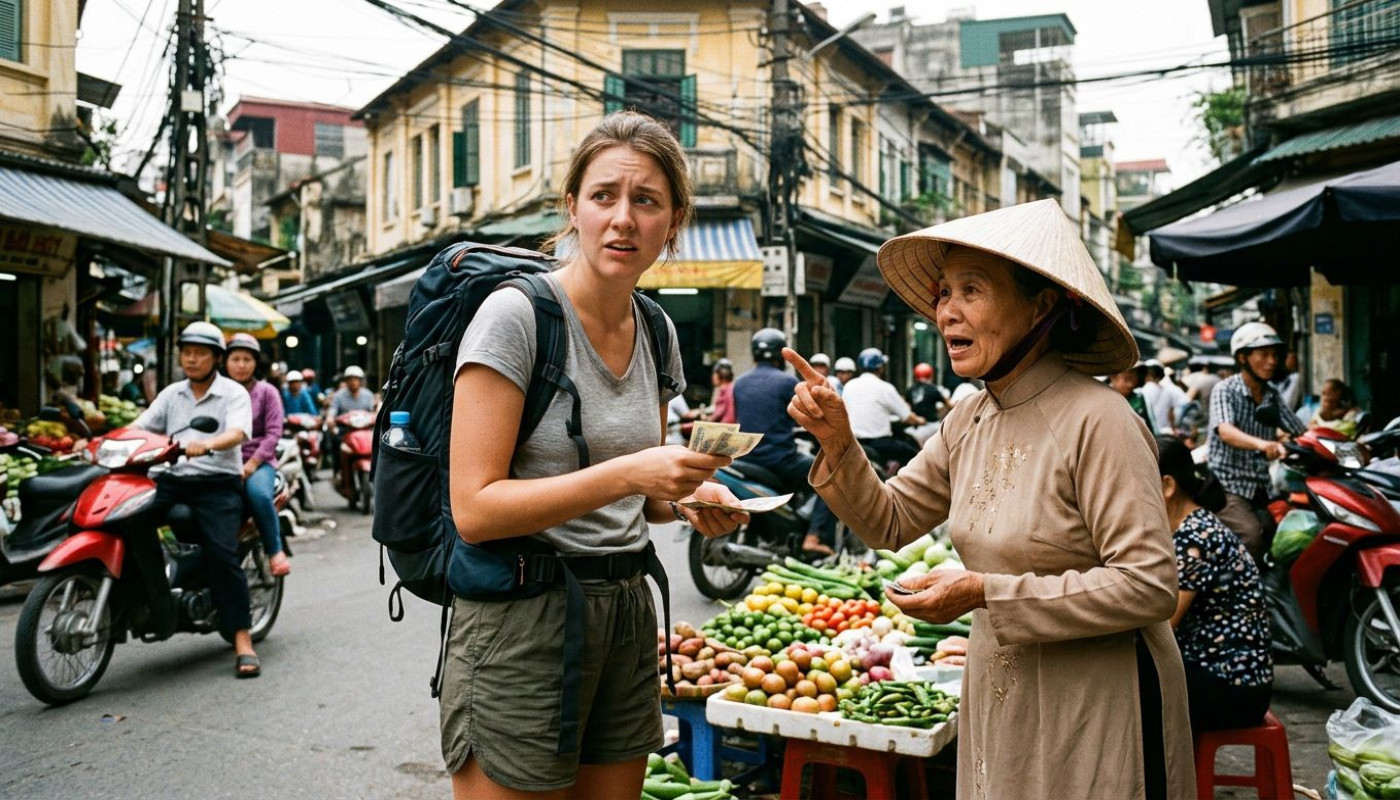
Money adds another layer, and it is one of the most misread signals in travel. Tipping, in particular, is a recurring flashpoint. In the United States, servers’ earnings are often structurally tied to gratuities, and leaving 15% to 20% is widely expected; in Japan, a tip can be refused, and may even feel insulting because service is built into the transaction as professional pride. In much of Europe, service charges can be included or tipping is modest, and in parts of the Middle East, small gratuities may be customary across multiple service interactions. Travelers who carry a single tipping philosophy tend to broadcast it, and locals notice, because money is never only money, it is also respect, status, and the shape of the relationship.
Dress codes and public behavior can also trigger quiet sanctions. In many religious sites, covering shoulders or hair is not a suggestion; it is a boundary, and crossing it reads as contempt for local life. In cities that have struggled with overtourism, from Venice to Barcelona, the sensitivity is heightened, and the local political mood matters. The European Commission and multiple municipal governments have documented the strain of tourism on housing and public space, and in some neighborhoods, the visitor is no longer a welcomed guest but a pressure on rents, noise, and infrastructure. That context changes the meaning of a bikini top in a supermarket, or a loud late-night balcony conversation, turning what seems trivial into a symbol of a larger conflict.
Safety, trust, and how cities train you
“Is it safe?” is a travel cliché, yet the deeper question is how a place teaches you to behave. In cities with high levels of social trust, you may see laptops left on café tables, children commuting independently, and a general softness in public interactions; in lower-trust environments, vigilance becomes competence. These differences are not just vibes. Global surveys consistently show wide variation in perceived safety and institutional trust, and while the exact rankings shift, the gap remains clear: Nordic countries often score high on trust metrics, while societies facing political instability or high inequality tend to show lower trust and higher fear of victimization. When visitors misread this, they can appear naïve, or worse, they can insult locals by treating everyone as a potential threat.
Policing and authority are another pressure point. In some countries, questioning an official can be seen as civic engagement, and in others it can escalate a situation fast, because authority is structured differently and dissent carries different risks. Even photographing in public can be sensitive, particularly around government buildings, military sites, or certain religious contexts. The traveler who assumes a universal right to document everything can stumble into legal trouble, but more commonly, they stumble into social trouble, because pointing a lens at someone without consent can feel like extraction, a taking of image and dignity without exchange.
Digital habits amplify these clashes. Posting geotagged “hidden gems” can contribute to sudden crowds in fragile places, and local authorities increasingly react; some destinations have introduced restrictions, permits, or fines aimed at controlling flows, and many have launched campaigns encouraging respectful behavior. Here, too, the conflict is about scale: what feels like one person’s harmless post becomes thousands of arrivals, and locals experience it as disruption. Travel teaches this brutally, because it forces you to see that individual choices aggregate, and the destination is not a stage, it is a lived-in system with limits.
Turning friction into better travel choices
There is a way through the awkwardness, and it is not performative humility. The best travelers build a simple toolkit: learn the greeting, learn the apology, and learn the exit line that lets everyone save face. They read local news, not just travel guides, because politics and prices shape the mood in the street. They ask one specific question that invites instruction, “Is there a polite way to do this?”, and then they follow the answer even when it feels unnatural. It is not about erasing yourself; it is about reducing the cost of your presence.
It also means choosing experiences that create context rather than consume it. A neighborhood walk with a guide, a cooking class run by locals, or a small-group visit to cultural institutions can turn confusion into understanding, because someone explains the “why” behind the rule. For travelers heading to Singapore, for example, resources that frame etiquette, neighborhoods, and cultural expectations can help you navigate a place where public order is taken seriously, and where the social fabric is multi-ethnic, multi-faith, and attentive to shared space; exploring https://www.singapore-spirit.com can be a practical starting point for shaping an itinerary that feels informed rather than improvised.
Finally, accept that discomfort is data. If a joke falls flat, if a waiter bristles, if a stranger corrects you, treat it as information about local values, not as a personal attack. The destination is teaching you in real time, and the lesson is usually consistent: your habits are not universal, your assumptions are visible, and your respect is measurable in small, repeatable behaviors. Travel, at its best, does not just show you monuments, it shows you the edges of your own culture, and it invites you to return home with a slightly better sense of how other people live.
Planning it well, spending it wisely
Book early when demand spikes, especially around school holidays and major festivals, because flight and hotel prices can jump fast, and last-minute bargains are less reliable than they used to be. Build a realistic daily budget that includes local transport and small fees, then keep a buffer for price surprises, because inflation and currency swings can change the math between planning and departure.
Check whether you qualify for discounts or travel support, from youth and student fares to senior reductions and city passes, and read the conditions before you pay. If you want fewer cultural missteps, reserve one guided experience at the start: it often pays for itself in confidence, time saved, and smoother interactions.
Similar

Packing Mistakes That Changed My Trip—unexpected Lessons From Fellow Explorers

Sint Maarten: An Exceptional Lifestyle That Inspires Real Estate Investment with 4U Real Estate

Exploring The Impact Of Cancellation Policies On Travel Flexibility

Facebook's profits hit $11.2 billion last year

Facebook suspends Israeli Prime Minister Benjamin Netanyahu-linked chatbot

32 people killed by suicide bombers in Baghdad

Florida data analyst turns herself in after accusing Florida of falsifying coronavirus data
